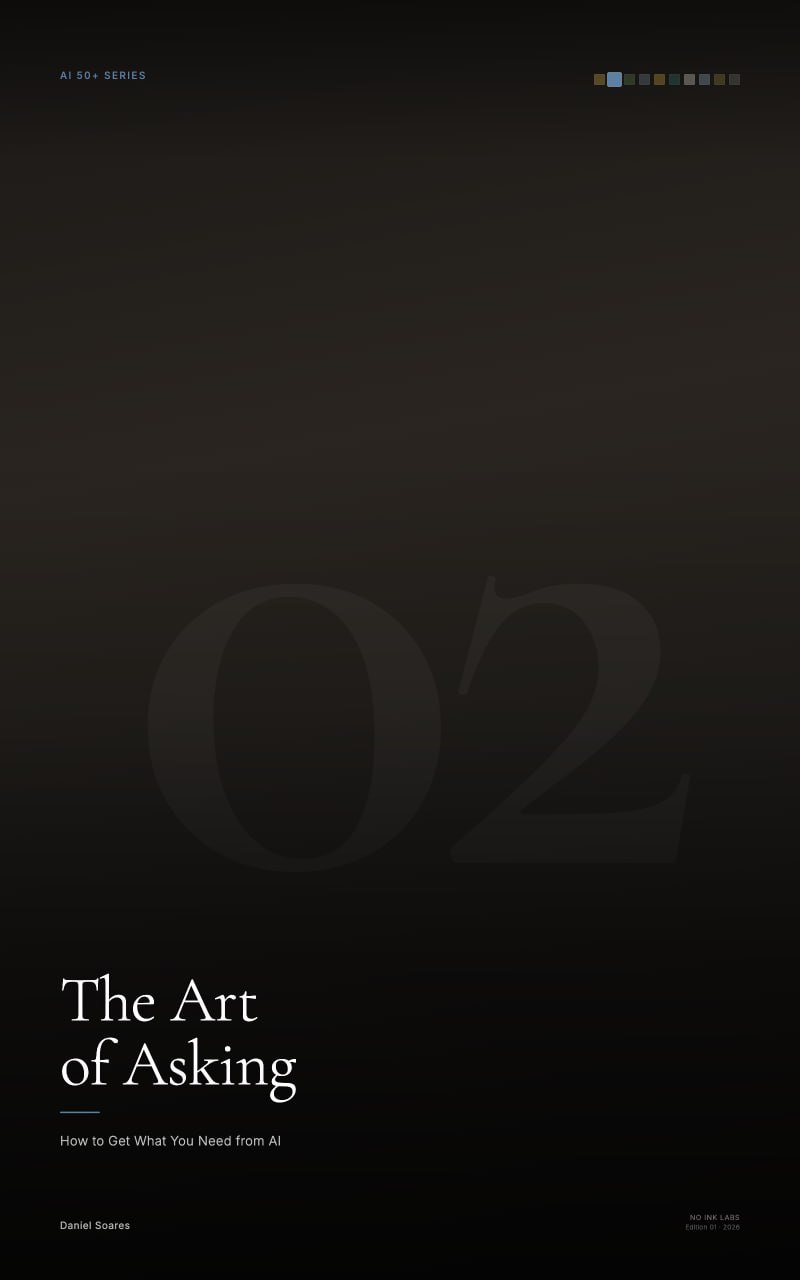
VOLUME 02 • AI 50+ SERIES
The Art of Asking
How to Get What You Need from AI
GET THIS BOOK
~2-hour read• Ebook• Audiobook
BOOK DESCRIPTION
The Art of Asking is Book 2 of the AI 50+ Series from No Ink Labs, written for experienced professionals who want practical AI fluency without hype, jargon, or a beginner’s loss of confidence. This volume focuses on how to get what you need from ai, turning the subject into clear daily judgment, usable workflows, and concrete next steps. Inside, readers move from why most people get weak answers through how to ask for better thinking, then into the habits and boundaries that make AI useful rather than distracting. The book is intentionally concise: enough depth to act, no filler, and no vendor-driven recommendations. It is designed for people who already bring career experience, domain knowledge, and taste to the table, and who need AI to support better work instead of replacing their own judgment. Buy the standalone ebook, add the matching audiobook, or continue into the complete series when you are ready for the broader path.
TABLE OF CONTENTS
- 01Why Most People Get Weak Answers
- 02Prompting Is Not Magic — It Is Instruction
- 03The Four Parts of a Strong Prompt
- 04Role, Context, Objective, Constraint
- 05How to Ask for Better Thinking
- 06How to Ask for Better Writing
- 07How to Ask for Better Research
- 08How to Ask for Better Strategy
- 09Iteration — The Second Prompt Is Where It Gets Good
- 10Refinement Patterns That Save Time
- 11Common Prompting Mistakes
- 12Personal Prompt Templates for Daily Use
- 13Building Your Own Prompt Library
- 14Closing Notes — Precision as a Professional Advantage
SAMPLE CHAPTER
Why Most People Get Bad Answers (And Think AI Is the Problem)
The most common experience with AI goes something like this: you ask it a question, it gives you an answer that’s technically correct but completely generic, you’re disappointed, and you conclude that AI is oversold.
You’re wrong. AI isn’t oversold. You just asked it a bad question.
This isn’t obvious because we’re trained by Google to ask simple questions and get useful answers. You type three keywords and you get what you’re looking for. This works for searching the internet because Google is finding existing information. But AI doesn’t find information. It generates information based on whatever cues you give it.
If you ask AI: “Write me a professional email about a project delay,” you’ll get a competent but generic email. It could apply to any project, any person, any situation. It’s useless because it has no context. You might as well have asked Google for “professional email template” and gotten the same result.
But if you ask: “Write me a professional email about the production delay on our manufacturing systems implementation. The client is a healthcare network that’s already behind schedule. They’re frustrated with us. I need to take responsibility without making excuses, explain what went wrong, show what we’re doing to fix it, and propose a new timeline they’ll actually believe. My tone should be direct and professional but warm — we’ve had a good relationship and I want to preserve it,” you’ll get something you can actually use. It will be specific to your situation. It will reflect your voice. You might need to edit it, but it will be work — refinement — not creation.
— END OF SAMPLE —
Keep reading The Art of Asking
Get the full book in your preferred format.
THE COMPLETE SERIES
Read the full AI 50+ Series
10 ebooks + 10 audiobooks. A structured path from AI uncertainty to confident everyday use — written for experienced professionals.
GET THE FULL SERIES + AUDIO — $99.99